Model Orchestration Is the Decisive New SDLC
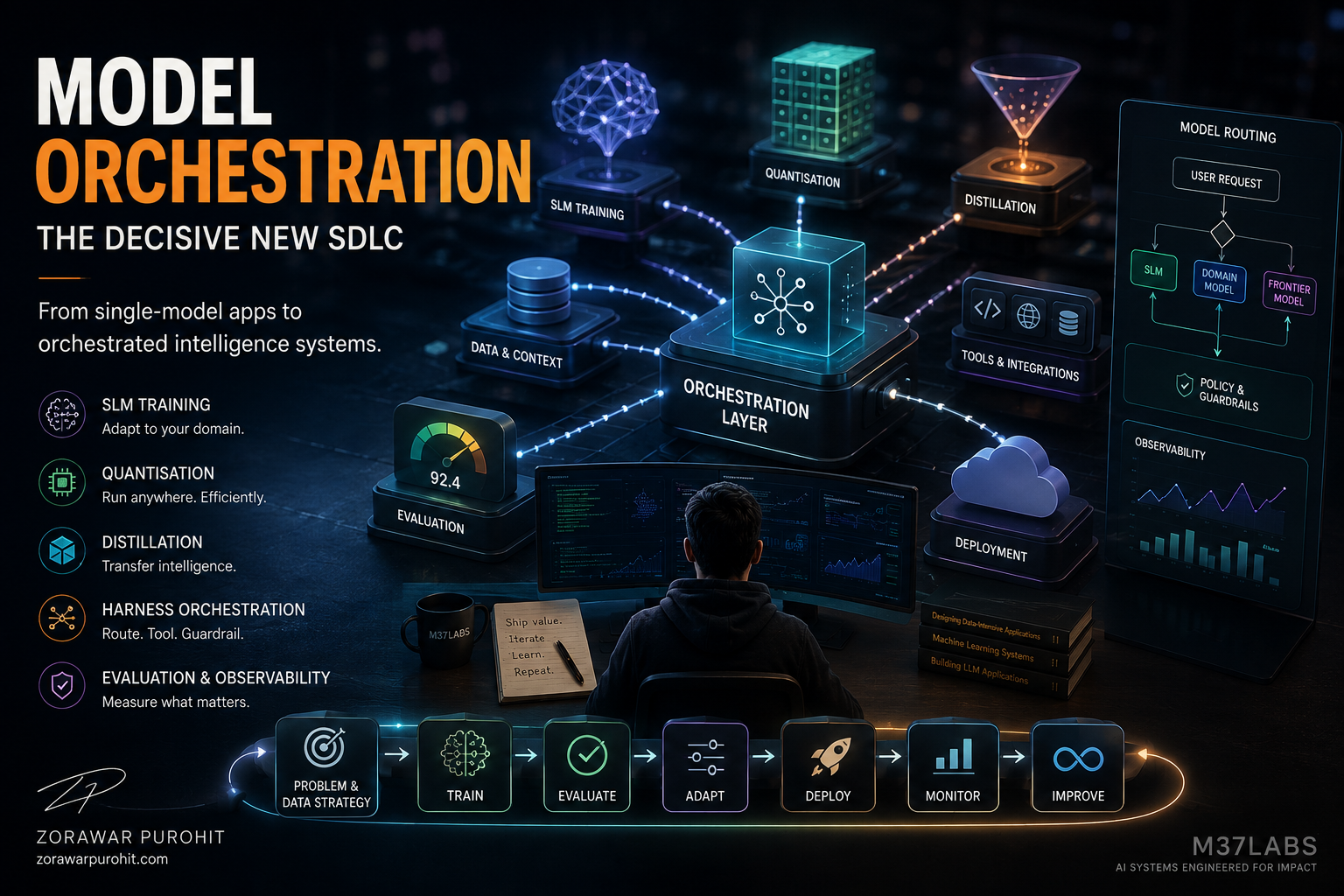
The next generation of software will not be defined by a single model. It will be defined by how intelligently we train, compress, route, evaluate and govern a portfolio of models.
For most of software history, the central engineering challenge was relatively clear: translate a defined business requirement into deterministic code.
The requirement entered a familiar lifecycle. It moved through discovery, architecture, development, testing, deployment, monitoring and maintenance. We refined this process through Agile, DevOps, CI/CD, cloud-native infrastructure and increasingly sophisticated observability.
That lifecycle is not disappearing.
But I believe it is no longer the decisive lifecycle.
In AI-native systems, application code increasingly becomes the outer structure around a changing, probabilistic and partially trainable intelligence layer.
The quality of the product is no longer determined only by whether the code works. It is determined by:
- Which model is used
- What that model has learnt
- How it has been adapted
- What context it receives
- Which tools it can access
- When another model should replace it
- How the complete system behaves under real-world uncertainty
The decisive new SDLC is therefore model orchestration.
I use the term broadly. I am not referring merely to placing a router in front of several commercial APIs.
Model orchestration includes the complete lifecycle through which intelligence is designed, trained, adapted, compressed, evaluated, deployed, observed and continuously improved.
That includes:
- Data curation and synthetic data generation
- Small Language Model training and domain adaptation
- Supervised and parameter-efficient fine-tuning
- Knowledge distillation
- Quantisation and pruning
- Prompt, context and retrieval engineering
- Tool use, memory, guardrails and structured outputs
- Model routing and fallback strategies
- Evaluation harnesses and regression testing
- Inference optimisation, monitoring and governance
The traditional SDLC still builds the vessel.
Model orchestration determines the intelligence navigating it.
Software Has Become Probabilistic
Traditional software is built around explicit instructions.
When a user clicks a button, the application executes a known function. When an API receives valid input, it should produce a predictable response. When a test fails, we can usually trace the failure to a specific piece of logic.
AI systems behave differently.
A model can return two different but individually valid answers to the same question. It can succeed on a complex request and fail on a simpler variation. It may perform well on a benchmark but poorly within the vocabulary, ambiguity and operational constraints of a particular business.
This changes the nature of engineering.
The fundamental question is no longer simply:
Does the software function correctly?
It becomes:
Does the complete intelligence system behave acceptably, reliably and economically across the distribution of situations it will encounter?
That is a much harder question.
It cannot be answered through conventional unit testing alone. It requires datasets, evaluators, behavioural thresholds, adversarial testing, human review, production telemetry and an explicit understanding of acceptable failure.
An AI product is never simply integrated with a model.
It is operating a living model system.
The Model Is Not the Product
One of the most common mistakes I see is treating the model as the finished intelligence layer.
A team selects a frontier model, writes a system prompt, connects a vector database and assumes the difficult work has been completed.
It has usually only begun.
The model is a component. The product emerges from the system around it.
A production AI system may need to determine:
- Whether the request is safe and within scope
- Whether the user has sufficient permission
- Whether fresh internal information must be retrieved
- Which documents should enter the context window
- Which model is appropriate for the request
- Whether a tool or external system should be invoked
- Whether the response needs deterministic validation
- Whether another model should critique the answer
- Whether uncertainty should be surfaced to the user
- Whether the task should be escalated to a human
This is the model harness.
The harness transforms a general-purpose model into an operational system.
It contains prompts, retrieval, memory, routing, tools, policies, schemas, validators, retries, fallbacks, telemetry and evaluation hooks.
A significant amount of durable enterprise value will be created within this layer.
Models will continue improving. Their relative strengths will change. Prices will move. Open models will catch up in some areas and diverge in others. New architectures will appear. Hardware will evolve.
A well-designed harness allows an enterprise to benefit from these changes without rebuilding its complete product every time.
That is why I see the orchestration layer as more durable than allegiance to any individual model provider.
Small Language Models Change the Economics
The future will not be composed entirely of enormous models answering every request.
Large frontier models are immensely useful, particularly for ambiguous, multi-step and reasoning-intensive work.
But using the most capable model for every task is the computational equivalent of sending a Formula One car to collect groceries.
It works.
It is also absurdly inefficient.
Small Language Models, or SLMs, offer a different operating model.
Their importance comes less from an exact parameter threshold and more from their ability to perform focused tasks with lower latency, reduced memory requirements and greater deployment flexibility.
An SLM does not need to know everything.
It may only need to:
- Classify an incoming request
- Extract fields from a document
- Detect policy violations
- Generate SQL within a constrained schema
- Summarise a specific type of report
- Route a request to the appropriate workflow
- Answer questions within one governed domain
- Produce structured output from predictable inputs
When the task distribution is narrow and well understood, specialisation can be more valuable than generality.
This changes how I think about enterprise AI architecture.
Instead of one universal model, I see a portfolio:
- A frontier model for difficult, novel or high-value reasoning
- A domain model for specialised organisational knowledge
- Several SLMs for repetitive, high-volume tasks
- Embedding and reranking models for retrieval
- Vision, speech and document models for multimodal inputs
- Safety and policy models for classification and control
- Local models for private, offline or latency-sensitive workloads
The value lies in deciding which intelligence should operate where.
Training Is Becoming a Product Capability
Most organisations should not begin by training a foundation model from scratch.
The cost, data requirements, infrastructure complexity and research talent needed to do this properly remain substantial.
For most enterprises, the rational starting point is to adapt an existing model.
But adaptation itself is becoming a core software capability.
Supervised fine-tuning allows a model to learn patterns from curated input-output examples.
Parameter-efficient methods allow organisations to adapt a model without retraining every parameter. Techniques such as LoRA introduce smaller trainable components while keeping most of the underlying model fixed.
Quantisation-aware approaches can reduce the memory needed during adaptation even further.
The practical lesson is not that every organisation must immediately begin fine-tuning.
The lesson is that the boundary between application development and model development is dissolving.
A modern product team may continuously:
- Capture difficult or failed production cases.
- Review and label high-value examples.
- Add those examples to an evaluation dataset.
- Improve prompts, retrieval or context selection.
- Fine-tune or adapt a model when prompting is insufficient.
- Compare the adapted model against the previous version.
- Deploy it gradually.
- Monitor whether the improvement survives real production traffic.
That is a software lifecycle.
Only now, part of the software is learnt rather than explicitly written.
Distillation Turns Frontier Intelligence into Operational Intelligence
Knowledge distillation is one of the most important mechanisms in this transition.
At its simplest, a larger and more capable teacher model produces examples, labels, reasoning demonstrations or probability distributions that help train a smaller student model.
The objective is not to reproduce the teacher's complete intelligence.
It is to transfer useful behaviour within a defined task distribution.
This is strategically important.
A frontier model may be used during exploration because it performs well before the organisation fully understands the task.
Over time, the business collects real examples, identifies recurring patterns and defines what a good answer actually looks like.
At that point, the frontier model can become a teacher.
Its successful outputs can be reviewed, filtered and transformed into training data for a smaller model.
The smaller model can then handle the common path, while the larger model remains available for exceptional cases.
This creates a practical intelligence ladder:
Frontier model
      ↓
Curated demonstrations
      ↓
Distilled specialist
      ↓
Production feedback
      ↓
Improved specialist
The result can be:
- Lower inference cost
- Lower latency
- Greater deployment flexibility
- More predictable behaviour
- Increased organisational control
But distillation is not magic compression.
A student model will not automatically inherit every capability of its teacher. The quality of the training data, task boundaries, filtering process and evaluation methodology determines whether the distilled model is genuinely useful.
Distillation must therefore be treated as an engineering programme, not a checkbox.
Quantisation Is a Deployment Decision
Training or selecting a good model is only part of the problem.
It must also run somewhere.
Quantisation reduces the numerical precision used to represent model weights and, depending on the technique, activations.
Instead of retaining every value at high precision, the model may use eight-bit, four-bit or another more compact representation.
This can substantially reduce the memory needed to load a model and may improve inference efficiency.
That is what makes quantisation strategically interesting.
A model that previously required expensive data-centre hardware may become deployable on:
- A smaller GPU
- An edge server
- An enterprise workstation
- A private cloud environment
- A capable consumer device
- Dedicated hardware near the point of use
This enables new product choices:
- On-premise inference for sensitive enterprise data
- Offline or intermittently connected applications
- Lower-cost private deployments
- Faster responses closer to the user
- Dedicated models for individual customers or workflows
- Reduced dependence on external inference providers
However, quantisation introduces trade-offs.
Lower precision can affect model quality, and the impact is not uniform across models, layers or tasks.
A quantised model that performs well on a general benchmark may still lose reliability on the exact edge cases that matter to a business.
This means quantisation cannot be approved purely through infrastructure benchmarks.
It must pass the same domain-specific evaluation harness as the original model.
I would not ask only:
How much memory did we save?
I would also ask:
Which capabilities weakened, by how much, under what conditions and does the new cost-performance ratio still meet the product requirement?
That is the difference between compression and engineering.
The Harness Is the New Application Runtime
The real intelligence of an AI-native product often lives in the interactions between components.
Consider an enterprise legal assistant.
The system may:
- Classify the request.
- Confirm the user's permissions.
- Retrieve relevant clauses from a contract repository.
- Rerank the retrieved information.
- Choose a model based on complexity.
- Generate a response within a structured schema.
- Verify that each claim has supporting evidence.
- Escalate low-confidence outputs to a lawyer.
No single model performs the complete job.
The harness creates the behaviour.
A mature harness may include several orchestration layers.
Context orchestration
The system decides what information enters the model's limited context window.
More context is not automatically better.
Irrelevant information can distract the model, increase cost and make failures harder to diagnose.
Retrieval therefore requires:
- Document parsing
- Chunking
- Metadata filters
- Semantic search
- Ranking and reranking
- Permission-aware access
- Citation and source tracking
Tool orchestration
The model may call:
- Search systems
- Databases
- Calculators
- Enterprise APIs
- Workflow platforms
- Code execution environments
- Communication systems
- Document generation services
But tool use requires contracts.
Inputs must be validated. Permissions must be enforced. Side effects must be controlled. Errors must be handled. High-risk actions may require human approval.
Memory orchestration
Some information belongs only to the current interaction.
Some may remain useful across a session.
Some may be retained as a durable preference.
Some should never be stored.
Memory is therefore not merely a vector database feature.
It is a product, privacy and governance decision.
Policy orchestration
The system must determine:
- What it may answer
- What information it may reveal
- What actions it may take
- Which data sources it may access
- When it must stop
- When a human must intervene
Policies can be implemented through deterministic rules, classifiers, specialised safety models or combinations of these.
Response orchestration
Outputs may require:
- Citation checking
- Schema validation
- Deterministic calculations
- Cross-model critique
- Policy verification
- Human review
- Confidence thresholds
This is why I do not think prompt engineering adequately describes the work.
Prompting is one instrument inside a much larger runtime.
Model Routing Will Become Standard Architecture
Once an organisation operates multiple models, it needs a rational way to choose between them.
The simplest router uses static rules.
A classification request goes to a small model. A difficult reasoning request goes to a frontier model. Sensitive workloads stay on-premise. A provider outage triggers a fallback.
More advanced routers can estimate:
- Task complexity
- Model confidence
- Expected response quality
- Latency
- Inference cost
- Privacy requirements
- Context length
- Tool support
- Geographic restrictions
- Provider availability
This is the direction in which AI architecture is moving.
The application should not need to know that one model is always the model.
It should request a capability:
- Extract these entities.
- Draft a compliant response.
- Resolve this ambiguity.
- Generate code against this repository.
- Analyse this image.
- Verify this answer.
- Escalate if confidence is insufficient.
The orchestration layer should determine the most appropriate intelligence resource.
Over time, model routing will resemble workload scheduling in cloud infrastructure.
We do not expect every computing task to run on the largest available machine. We allocate resources according to need.
Intelligence will be allocated in the same way.
Inference Engineering Is Part of the Product
Even after choosing the model, adaptation method and quantisation format, performance still depends on how inference is served.
Several factors can materially affect latency and throughput:
- Request batching
- Prefix and semantic caching
- Tensor and pipeline parallelism
- Attention optimisation
- Context-window management
- Speculative decoding
- Model loading strategies
- Hardware utilisation
- Concurrent request scheduling
This matters because users do not experience model architecture papers.
They experience response time.
A model that is marginally more accurate but consistently slow may create a worse product.
A cheaper model that requires repeated retries may cost more in practice.
A locally deployed model may offer excellent privacy but insufficient throughput during peak demand.
Model orchestration must therefore optimise for the complete service-level objective:
Quality × Latency × Cost × Reliability × Privacy
Optimising one dimension in isolation usually produces a distorted answer.
Evaluations Are the New Tests
Traditional software testing asks whether known inputs produce expected outputs.
AI evaluation is more complicated because several answers may be acceptable and quality may be multidimensional.
A useful evaluation system may measure:
- Task accuracy
- Factual grounding
- Citation correctness
- Instruction adherence
- Tool selection
- Structured-output validity
- Safety and policy compliance
- Latency and cost
- Robustness against ambiguous inputs
- Robustness against adversarial inputs
- Consistency across languages, users and contexts
I see evaluations as the equivalent of tests for probabilistic systems.
They should be version-controlled.
They should run before deployment.
They should contain real examples.
They should include known failure cases.
They should be segmented by business importance rather than reduced to one average score.
A model may improve from 82 to 86 per cent overall while becoming worse on the five per cent of cases that create regulatory or financial risk.
The average improved.
The product did not.
That is why a serious evaluation harness needs:
- Dataset slices
- Per-category thresholds
- Failure taxonomies
- Escalation rules
- Human review
- Regression tracking
Automated evaluators are useful, including model-based graders, but they can introduce their own biases and blind spots.
High-value domains still require expert review and periodic calibration against real human decisions.
The feedback loop becomes:
Production cases
      ↓
Evaluation data
      ↓
Model or harness change
      ↓
Regression testing
      ↓
Controlled deployment
      ↓
Production observation
This is CI/CD redesigned for learnt systems.
From CI/CD to Continuous Intelligence Delivery
The classical delivery pipeline packages and deploys code.
The AI-native pipeline must package and deploy an intelligence configuration.
That configuration may include:
- Model identifiers and exact versions
- Adapter weights
- Quantisation formats
- Tokeniser versions
- System prompts
- Retrieval configurations
- Tool definitions
- Policy rules
- Routing thresholds
- Evaluation datasets
- Acceptance thresholds
- Rollback conditions
Changing any one of these can alter the behaviour of the product.
A prompt change can create a regression.
A model-provider update can modify response style.
A retrieval change can increase hallucination by surfacing poorer context.
A quantisation change can weaken accuracy.
A new tool can expand the system's risk surface.
Every meaningful intelligence-layer change therefore needs:
- Versioning
- Testing
- Traceability
- Controlled rollout
- Monitoring
- Rollback capability
I call this Continuous Intelligence Delivery.
The objective is not to deploy models frequently for the sake of movement.
The objective is to improve the system without losing control over why its behaviour changed.
The Economics Favour Orchestration
The first generation of enterprise generative AI largely focused on access.
Could the company connect to a capable model?
Could it build a chatbot?
Could it retrieve internal documents?
The next generation will focus on economics.
What does each successful task cost?
Not each token.
Each successful task.
A cheap model that fails repeatedly is not cheap.
A frontier model that resolves a high-value problem in one attempt may offer excellent value.
A locally hosted model may have a higher fixed cost but a lower marginal cost at scale.
The correct unit of analysis depends on the product:
- Cost per resolved support request
- Cost per accurately processed document
- Cost per qualified lead
- Cost per accepted code change
- Cost per compliant legal draft
- Cost per completed workflow
- Cost per human hour saved
Model orchestration makes these economics manageable.
Routine traffic can flow to smaller models.
Difficult traffic can escalate.
Frequently repeated behaviours can be distilled.
Stable models can be quantised.
Retrieval can reduce unnecessary context.
Caching can prevent repeated work.
Failed outputs can be detected before they create downstream damage.
The goal is not to minimise model cost.
The goal is to maximise useful intelligence per unit of cost.
Governance Moves into the Engineering Core
AI governance cannot remain a policy document written after the product has already been built.
It must become part of the orchestration architecture.
A governed model lifecycle should answer:
- Which data was used for training or adaptation?
- Was that data authorised for this purpose?
- Which model version produced this decision?
- What prompt and context did it receive?
- Which tools did it invoke?
- What policy checks were applied?
- Which evaluator approved the output?
- Can the result be meaningfully audited?
- When should a human have been involved?
This is particularly important when models influence financial, legal, healthcare, employment or safety-related decisions.
The more autonomous the system becomes, the stronger its identity, permission and audit layers must become.
Agency without governance is merely automated risk.
The Team Structure Must Change
The traditional separation between software, data science, machine learning and product teams will become increasingly difficult to maintain.
Model orchestration cuts across all of them.
A production system may require:
- Product leaders who can define acceptable behaviour
- Domain experts who can judge output quality
- Data engineers who can build reliable information pipelines
- ML engineers who can adapt and optimise models
- Software engineers who can build harnesses and integrations
- Platform engineers who can operate inference infrastructure
- Security and governance specialists who can constrain the system
- Evaluation engineers who can measure whether it actually works
The most valuable teams will not merely know how to call a model API.
They will know how to convert an ambiguous business capability into a measurable intelligence contract.
That contract should define:
- What the system must do.
- What it must never do.
- What quality threshold is acceptable.
- Which failures can be tolerated.
- Which failures require escalation.
- What latency and cost are viable.
- Which data and deployment boundaries apply.
- How improvement will be measured over time.
Without this, model selection becomes theatre.
Teams debate which model appears smartest without agreeing on the work it must perform.
A Practical Model-Orchestration Lifecycle
I would structure the new lifecycle through the following stages.
1. Define the intelligence contract
Start with the job, not the model.
Specify:
- The user
- The task
- The domain
- The risks
- The expected output
- The acceptable uncertainty
- The latency target
- The economic ceiling
2. Build the evaluation set
Collect representative examples before optimising.
Include:
- Normal requests
- Difficult edge cases
- Adversarial inputs
- Ambiguous instructions
- Situations requiring clarification
- Situations requiring refusal
- Situations requiring human escalation
3. Establish the frontier baseline
Use a highly capable model to understand what strong performance looks like.
This gives the team a practical upper baseline and helps reveal whether the task is technically feasible.
4. Design the harness
Add:
- Retrieval
- Tools
- Schemas
- Permissions
- Memory
- Policies
- Deterministic validation
Many apparent model problems are actually context, workflow or interface problems.
5. Select the model portfolio
Choose which tasks require frontier intelligence and which can be handled by smaller, specialised or local models.
6. Adapt where necessary
Use prompt and context improvements first when appropriate.
Move to supervised fine-tuning, LoRA or another adaptation method when repeated behavioural gaps remain.
7. Distil stable behaviours
Once high-quality examples accumulate, train smaller specialists to handle predictable traffic.
8. Quantise for the target hardware
Optimise models for the environment in which they must actually operate.
Then rerun the complete evaluation suite.
9. Engineer inference
Measure:
- Throughput
- Time to first token
- Inter-token latency
- Concurrency
- Cache effectiveness
- Hardware utilisation
10. Route dynamically
Send each request to the least expensive model capable of meeting the intelligence contract.
11. Deploy progressively
Use:
- Shadow traffic
- Canary releases
- Feature flags
- Controlled cohorts
- Explicit rollback thresholds
12. Learn from production
Capture:
- Failures
- Corrections
- Escalations
- User feedback
- Accepted outputs
- Rejected outputs
- Cost and latency data
Feed these signals back into evaluation, data curation and future model versions.
This is not a straight line.
It is a loop.
What I Would Avoid
I would avoid building an AI strategy around a single model vendor.
I would avoid treating benchmark leadership as proof of product suitability.
I would avoid fine-tuning before building a credible evaluation set.
I would avoid quantising a model and approving it solely because it fits on cheaper hardware.
I would avoid using a frontier model for every trivial request.
I would avoid allowing model-generated outputs to trigger consequential actions without deterministic controls and appropriate permissions.
I would avoid calling a collection of prompts an AI platform.
And I would especially avoid believing that the intelligence layer is finished once the first demonstration works.
Demos prove possibility.
Production proves repeatability.
Scale proves economics.
Governance proves maturity.
The Enterprise Asset Is the Orchestration Layer
Individual models will continue becoming more capable.
Some will be closed.
Some will be open.
Some will operate in the cloud.
Some will run on devices.
Some will specialise in reasoning, code, speech, images, video or robotics.
The winning enterprise architecture will not attempt to predict one permanent model champion.
It will create a system capable of continuously integrating the best available intelligence under explicit operational constraints.
The lasting enterprise asset will be the organisation's:
- Proprietary evaluation data
- Curated domain datasets
- Distillation pipelines
- Adapted specialist models
- Model-routing logic
- Tool and retrieval integrations
- Safety and governance controls
- Production feedback loops
- Understanding of where intelligence creates economic value
This is why I believe model orchestration is the decisive new SDLC.
The next era of software will not be won merely by teams that write the best code or gain the earliest access to the strongest model.
It will be won by teams that can systematically turn general intelligence into dependable, specialised and economically viable systems.
The model is becoming replaceable.
The orchestration is becoming the product.
And the ability to continuously engineer that orchestration will become one of the most valuable organisational capabilities of the AI-native era.
Keep reading
Training a Small Language Model: What I Learned About Probability, Context and Bias
A language model does not need a perfect description of reality to be useful. Training a small one made tokens, probability distributions, context windows and bias stop being buzzwords — and made the difference between statistical correctness and judgement surprisingly tangible.
The New Open Source War: AI Made Attacks Faster, But Defence Finally Caught Up
Open source is one of humanity’s finest acts of organised optimism. A developer writes something useful. Another improves it. A third builds a business on top of it. Then millions of applications silently depend on it. No grand permission. No central kingdom. Just code, trust, and momentum. That trust is now under stress. Not because…
GPT-5 Release
A Defining Leap for Enterprise AI and Developer Capability The release of GPT-5 marks a pivotal moment in artificial intelligence, one where performance benchmarks meet real-world applicability. This is not just another model iteration; it is an evolution in how AI thinks, reasons, interacts, and delivers results at production-ready quality. For both enterprise leaders and…